: a male figure used like a caryatid as a supporting column or pilaster
called alsotelamon
Illustration of atlas
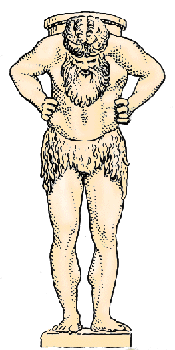
atlas 5
Did you know?
Word History of Atlas
In Greek mythology, giants ruled the world in an early age. Their rule was overthrown after a mighty battle with other gods. Atlas was one of these giants, and after their defeat, the story goes, he was forced to hold up the sky on his shoulders. In the 16th century, the Flemish mapmaker Gerardus Mercator published a collection of maps. On the title page he showed a picture of Atlas supporting his burden. Mercator gave the book the title Atlas. Later collections of maps included similar pictures of Atlas, and came to be called atlases.
Examples of atlas in a Sentence
a road atlas of the U.S.
Recent Examples on the Web
Examples are automatically compiled from online sources to
show current usage.Read More
Opinions expressed in the examples do not represent those of Merriam-Webster or its editors.
Send us feedback.
Because a dictionary, properly understood, isn’t just a repository, but an atlas that sets the contours of the explorable world.—Literary Hub,
1 July 2026 Later this year, the HCA expects to deliver a first draft — the completion of single-cell atlases across all of the major organs and tissues — that promise to boost researchers’ understanding of how the body works.—
Megan Molteni,
STAT,
16 June 2026 The brain atlas revealed that lipofuscin accumulates in specific regions both shared and unique to aging in typical mice and those lacking the PPT1 gene, underscoring areas vulnerable to lipofuscin accrual.—
Kristel Tjandra,
Hartford Courant,
5 June 2026 In another Amsterdam photo, a pair of identical world globes, recalling Ghirri’s passion for cartography and atlases, rest on matching supports to conjure that oldest of surrealist tropes, a pair of staring eyes.—
James Quandt,
Artforum,
2 June 2026 See All Example Sentences for atlas
Atlas was one of the giants of Greek mythology who ruled the world in an early age. Their rule was overthrown after a mighty battle with other gods. After his defeat, the story goes, Atlas was forced to hold up the sky on his shoulders. In the 16th century the Flemish mapmaker Gerardus Mercator published a collection of maps. On the title page he showed a picture of Atlas supporting his burden. Mercator gave the book the title Atlas. Later collections of maps included similar pictures of Atlas, and such books came to be called atlases.