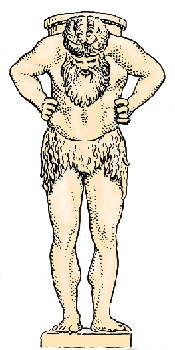
: a male figure used like a caryatid as a supporting column or pilaster
called alsotelamon
Illustration of atlas
atlas 5
Did you know?
Word History of Atlas
In Greek mythology, giants ruled the world in an early age. Their rule was overthrown after a mighty battle with other gods. Atlas was one of these giants, and after their defeat, the story goes, he was forced to hold up the sky on his shoulders. In the 16th century, the Flemish mapmaker Gerardus Mercator published a collection of maps. On the title page he showed a picture of Atlas supporting his burden. Mercator gave the book the title Atlas. Later collections of maps included similar pictures of Atlas, and came to be called atlases.
Examples of atlas in a Sentence
a road atlas of the U.S.
Recent Examples on the Web
Examples are automatically compiled from online sources to
show current usage.Read More
Opinions expressed in the examples do not represent those of Merriam-Webster or its editors.
Send us feedback.
An atlas of pathogens Five years ago, a study like this wasn't really possible, says Carlson.—Jonathan Lambert, NPR, 9 Apr. 2026 In an effort to better understand the impact of aging on brain function, scientists at the Salk Institute for Biological Studies recently delivered their most comprehensive single-cell atlas detailing epigenetic changes in the brains of mice.—Noah Lyons, San Diego Union-Tribune, 6 Apr. 2026 That’s big, but most Atlases will have a 15-inch touch screen — nearly as big as a McDonald’s tray — to manage smartphone, navigation, audio, climate control and more.—Mark Phelan, Freep.com, 31 Mar. 2026 The resulting paper described the cerebral cortex as an atlas of meaning.—Eric Boodman, Vulture, 25 Mar. 2026 See All Example Sentences for atlas
Atlas was one of the giants of Greek mythology who ruled the world in an early age. Their rule was overthrown after a mighty battle with other gods. After his defeat, the story goes, Atlas was forced to hold up the sky on his shoulders. In the 16th century the Flemish mapmaker Gerardus Mercator published a collection of maps. On the title page he showed a picture of Atlas supporting his burden. Mercator gave the book the title Atlas. Later collections of maps included similar pictures of Atlas, and such books came to be called atlases.