: a large semiaquatic constricting snake (Eunectes murinus) of the boa family of tropical South America that may reach a length of 30 feet (9.1 meters)
broadly: any of the large constricting snakes
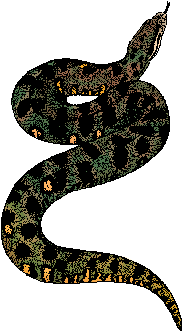
Illustration of anaconda
Did you know?
Important Anaconda Facts
There are two species of South American snakes that constrict their prey. The heavily built giant anaconda is usually about 16 ft (5 m) long, but can be longer than 24 ft (7.5 m), rivaling the largest pythons in length. The yellow anaconda is much smaller. Typically dark green with alternating oval black spots, the giant anaconda lives along tropical rivers east of the Andes and in Trinidad. It kills at night by lying in wait in water; it constricts prey as large as young pigs or caimans and occasionally forages in trees for birds. It may bear 75 live young at a time.
Examples of anaconda in a Sentence
Recent Examples on the Web
Examples are automatically compiled from online sources to
show current usage.Read More
Opinions expressed in the examples do not represent those of Merriam-Webster or its editors.
Send us feedback.
But things get real when an actual giant anaconda appears, turning their comically chaotic movie set into a deadly situation.—Tim Lammers, Forbes.com, 24 Jan. 2026 British explorer Colonel Percy Fawcett, who wandered the Amazon for 22 years at the beginning of the 20th century before vanishing without a trace, wrote that the breath of the anaconda stupefied its prey.—Stanley Stewart, Travel + Leisure, 10 Jan. 2026 According to National Geographic, green anacondas are non-venomous, constricting snakes native to South America and are members of the boa family.—Kimberlee Speakman, PEOPLE, 10 Jan. 2026 The project starts to unravel when life imitates art and a real anaconda begins hunting them down.—Rebecca Rubin, Variety, 28 Dec. 2025 See All Example Sentences for anaconda
Word History
Etymology
probably modification of Sinhalese henakandayā, a slender green snake
city in southwestern Montana that grew rapidly following the building of a copper-smelting plant in 1884 and expanded to contain one of the largest nonferrous production plants in the world population 9298