The volcano last erupted 25 years ago.
after months of tension the roommates' living situation was a volcano
Recent Examples on the Web
Examples are automatically compiled from online sources to
show current usage.Read More
Opinions expressed in the examples do not represent those of Merriam-Webster or its editors.
Send us feedback.
Trouble began during their descent Sunday night from the Shasta summit, a potentially active volcano 60 miles south of the Oregon-California border.—
Darrell Smith,
Miami Herald,
3 Sep. 2026 Indonesia is an archipelago of more than 280 million people with frequent seismic activity and Sinabung is among more than 120 active volcanoes.—ABC News,
31 Aug. 2026 Mount Rainier National Park, Washington Washington’s Mount Rainier National Park is named for the tallest volcano in the Cascade Range.—
Giovanna Caravetta,
Travel + Leisure,
25 Aug. 2026 Earth’s moon—which also has the advantage of being 50 percent larger than Pluto and of having volcanoes that once spewed actual lava instead of mere water—fully deserves planethood by these very same metrics.—
Mike Brown,
Scientific American,
24 Aug. 2026 See All Example Sentences for volcano
Word History
Etymology
Italian or Spanish; Italian vulcano, from Spanish volcán, ultimately from Latin Volcanus Vulcan
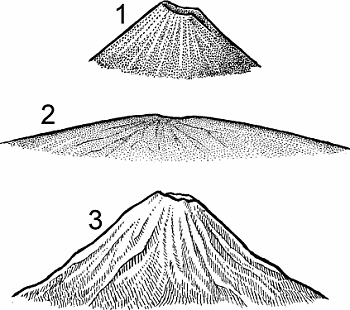
: a vent in the earth's crust from which melted or hot rock and steam come out
also: a hill or mountain composed entirely or in part of the material thrown out
Etymology
from Italian or Spanish; Italian vulcano "volcano," from Spanish vulcán, from Latin Volcanus, Vulcanus "Vulcan (Roman god of fire)"
Word Origin
The ancient Greeks and Romans had many gods and goddesses. Each of these deities was in charge of a special kind of work or an aspect of nature. Many of the happenings in nature were explained in myth as the actions of one or more of these gods or goddesses. The Roman god of fire was known as Vulcanus in Latin (Vulcan in English). He was thought to live inside Mount Etna, a volcano on the island of Sicily. Vulcan was a giant who worked as a blacksmith, forging the thunderbolts for Jupiter, king of the gods. The smoke and occasional fiery rocks and lava that came from Mount Etna were thought to be from Vulcan's forge. That is how his name came to be applied to a mountain that sometimes spews forth fire and smoke.


 Copy Citation