Noun
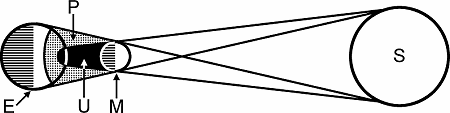
an eclipse of the sun
The popularity of television led to the eclipse of the radio drama.
an artist whose reputation has long been in eclipseVerb
The sun was partially eclipsed by the moon.
Train travel was eclipsed by the growth of commercial airlines.
Recent Examples on the Web
Examples are automatically compiled from online sources to
show current usage.Read More
Opinions expressed in the examples do not represent those of Merriam-Webster or its editors.
Send us feedback.
Noun
Those in London with eclipse glasses will see a 91% partial eclipse; in Paris, 92%; in Berlin, about 85%; and in Vienna, 87%.—
Jamie Carter,
Forbes.com,
21 July 2026 The partial eclipse here will be a technical affair, but the island's open beaches provide excellent naked-eye conditions for Perseid observing after dark, especially looking away from nearby coastal development.—
Jamie Carter,
Space.com,
19 July 2026
Verb
The woman whose video eclipsed hers was, until recently, in a very different professional space.—
Alli Kushner,
Forbes.com,
29 July 2026 Google’s 100 billion SynthID images and videos are just the tip of an iceberg that has already eclipsed authentic content on the Internet.—ArsTechnica,
29 July 2026 See All Example Sentences for eclipse
Word History
Etymology
Noun
borrowed from Middle English eclipse, clips, borrowed from Anglo-French eclyps, eclypse, borrowed from Latin eclīpsis, borrowed from Greek ékleipsis "abandonment, failure, cessation, obscuring of a celestial body by another," from ekleípein "to leave out, abandon, cease, die, be obscured (of a celestial body)" (from ek-ec- + leípein "to leave, quit, be missing") + -sis-sis — more at delinquent entry 2
Verb
Middle English eclypsen, clypsen, derivative of eclipseeclipse entry 1, probably after Medieval Latin eclīpsāre or Middle French esclipser


 Copy Citation