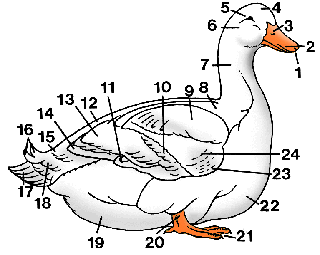
: any of various swimming birds (family Anatidae, the duck family) in which the neck and legs are short, the feet typically webbed, the bill often broad and flat, and the sexes usually different from each other in plumage—often used figuratively in phrases like have one's ducks in a row, get one's ducks in a row, or put one's ducks in a row to describe being or becoming thoroughly prepared or organized
Her program's 10-week curriculum … uses a budget book to help first-timers get their financial ducks in a row.—Eileen Jenkins
I'm to prepare for a formal review in two weeks. Reserve a conference room. Get all my ducks in a row.—Chuck Palahniuk
The association was set to move forward last spring, then realized it didn't have its ducks in a row and essentially requested a Congressional bailout.—Pat Forde
I was sure I had all of my ducks in a row before the event finally arrived. Somehow, it didn't turn out as planned.—Jerry Carlson
… had prepared for a year, meeting with institutional investors and putting its ducks in a row for public scrutiny for months …—Alex Konrad
Noun (1)
her coworkers regard her as something of an odd duckVerb
The ceiling was so low I had to duck my head.
He ducked his head so they wouldn't see him.
We can't afford to duck the issue any longer.
They've been ducking each other for months.
She ducked into a store when it started to rain.
He ducked around a corner.
Recent Examples on the Web
Examples are automatically compiled from online sources to
show current usage.Read More
Opinions expressed in the examples do not represent those of Merriam-Webster or its editors.
Send us feedback.
Noun
The largest of the three outbreaks has an unusually high number of patients reporting contact with ducks, specifically Pekin ducks.—CBS News, 18 May 2026 Dragon Casa is a Chinese-Mexican fusion taquería that offers Peking duck tacos and birria soup dumplings.—Ella Gonzales, Fort Worth Star-Telegram, 18 May 2026
Verb
Shawn Mendes stuck to his slate gray suit, sans shirt, and gamely posed for photos on the mansion’s steps before ducking down to the basement.—Leigh Nordstrom, Footwear News, 17 May 2026 As the family is photographed, several Aces members come in and pause for a brief hug and coo before ducking quickly out of frame.—Jade Chang, Los Angeles Times, 13 May 2026 See All Example Sentences for duck
Word History
Etymology
Noun (1)
Middle English duk, doke, from Old English dūce
Verb
Middle English douken; akin to Old High German tūhhan to dive, Old English dūce duck
Noun (3)
Dutch doek cloth; akin to Old High German tuoh cloth
First Known Use
Noun (1)
before the 12th century, in the meaning defined at sense 1a
: any of various typically web-footed swimming birds with the neck and legs short, the body heavy, the bill often broad and flat, and the males and females usually differing in color
also: the flesh of a duck used as food
duck
2 of 4verb
1
: to thrust or plunge underwater
2
: to lower the head or body suddenly
3
: to move quickly : disappear suddenly
he ducked around the corner to escape detection
4
: to evade a duty, question, or responsibility : dodgeentry 2
ducked our question
duckernoun
duck
3 of 4noun
1
: a coarse usually cotton cloth
2
plural: clothes made of duck
duck
4 of 4noun
: an amphibious truck
Etymology
Noun
Old English dūce "duck"
Verb
Middle English douken "thrust under water"
Noun
from Dutch doek "cloth"
Noun
altered form of DUKW, military code name for this vehicle
: any of various swimming birds (family Anatidae, the duck family) in which the neck and legs are short, the feet typically webbed, the bill often broad and flat, and the sexes usually different from each other in plumage


 Copy Citation