cell
cell
noun \ˈsel\Definition of CELL
1
: a small religious house dependent on a monastery or convent
2
a : a one-room dwelling occupied by a solitary person (as a hermit) b : a single room (as in a convent or prison) usually for one person
3
: a small compartment, cavity, or bounded space: as a : one of the compartments of a honeycomb b : a membranous area bounded by veins in the wing of an insect
4
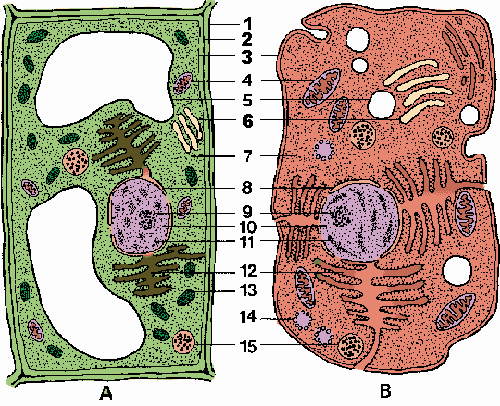
: a small usually microscopic mass of protoplasm bounded externally by a semipermeable membrane, usually including one or more nuclei and various other organelles with their products, capable alone or interacting with other cells of performing all the fundamental functions of life, and forming the smallest structural unit of living matter capable of functioning independently
5
a (1) : a receptacle containing electrodes and an electrolyte either for generating electricity by chemical action or for use in electrolysis (2) : fuel cell b : a single unit in a device for converting radiant energy into electrical energy or for varying the intensity of an electrical current in accordance with radiation
6
: a unit in a statistical array (as a spreadsheet) formed by the intersection of a column and a row
7
: a basic and usually small unit of an organization or movement <terrorist cells>
8
: a portion of the atmosphere that behaves as a unit <a storm cell>
9
a : any of the small sections of a geographic area of a cellular telephone system b : cell phone
Examples of CELL
- The suspect was in the police station's holding cell overnight.
- <his mission was to locate and infiltrate the terrorist cell that was believed to be hiding in the city>
Origin of CELL
Middle English, from Old English, religious house and Anglo-French celle hermit's cell, from Latin cella small room; akin to Latin celare to conceal — more at hell
First Known Use: 12th century
cell
noun \ˈsel\ (Medical Dictionary)Medical Definition of CELL
1
: a small compartment or bounded space
2
: a small usually microscopic mass of protoplasm bounded externally by a semipermeable membrane, usually including one or more nuclei and various nonliving products, capable alone or interacting with other cells of performing all the fundamental functions of life, and forming the smallest structural unit of living matter capable of functioning independently
cell
noun (Concise Encyclopedia)In biology, the basic unit of which all living things are composed; the smallest structural unit of living matter that is able to function independently. A single cell can be a complete organism in itself, as in bacteria and protozoans. Groups of specialized cells are organized into tissues and organs in multicellular organisms such as higher plants and animals. There are two distinct types of cells: prokaryotic cells and eukaryotic cells. Though the structures of prokaryotic and eukaryotic cells differ (see prokaryote, eukaryote), their molecular compositions and activities are very similar. The chief molecules in cells are nucleic acids, proteins, and polysaccharides. A cell is bounded by a membrane that enables it to exchange certain materials with its surroundings. In plant cells, a rigid cell wall encloses this membrane.
Learn More About CELL
Seen & Heard 
What made you want to look up cell? Please tell us where you read or heard it (including the quote, if possible).


See