specifically: of or relating to the internal affairs of a state or country
intestine war
Did you know?
We bet you thought intestine was a noun referring to a part of the digestive system! It is, of course, but naming that internal body part isn't the word's only function. Both the noun and the adjective intestine have been a part of English since the 15th century, and both trace to the Latin adjective intestinus, meaning "internal," and ultimately to intus, meaning "within." Though the adjective intestine turns up much less frequently than does its anatomical cousin, it does see occasional use, especially as a synonym for civil and domestic (in contrast to foreign) applied to wars and disturbances.
Examples of intestine in a Sentence
Recent Examples on the Web
Examples are automatically compiled from online sources to
show current usage.Read More
Opinions expressed in the examples do not represent those of Merriam-Webster or its editors.
Send us feedback.
Noun
This includes the skeletal muscles that Rocky uses to sprint and box, the muscles that allow your heart to beat, the muscles that squeeze food through your stomach and intestines, and the muscles that open up your airways to breathe.—
Linda M. Boland,
The Conversation,
21 Aug. 2026 Composition The human digestive tract contains trillions of microorganisms, the vast majority of which reside in the large intestine.—Encyclopedia Britannica,
19 Aug. 2026 Gavin said Shakur was also struck in the right thigh, with the bullet traveling into his abdomen and damaging his intestines.—
Liza Esquibias,
USA Today,
19 Aug. 2026 Those compounds increased while the astronauts were in space, suggesting food was spending more time moving through their intestines, according to the statement.—
Samantha Mathewson,
Space.com,
18 Aug. 2026 See All Example Sentences for intestine
Word History
Etymology
Noun
Middle English, from Middle French intestin, from Latin intestinum, from neuter of intestinus
Adjective
Middle English, from Middle French or Latin; Middle French intestin, from Latin intestinus, from intus within — more at ent-
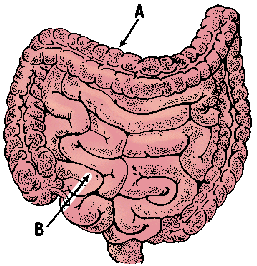
: the part of the alimentary canal that is a long tube composed of the small intestine and the large intestine, that extends from the stomach to the anus, that helps to digest food and absorb nutrients and water, and that carries waste matter to be discharged
: the tubular portion of the digestive tract that lies posterior to the stomach from which it is separated by the pyloric sphincter and consists of a slender but long anterior part made up of the duodenum, jejunum, and ileum which function in digestion and assimilation of nutrients and a broader shorter posterior part made up of the cecum, colon, and rectum which function in resorption of water from the by-products of digestion and formation of the feces—often used in plural
the movement of digested food through your intestines—Mayo Clinic Health Letter