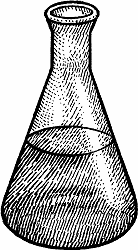
Illustration of Erlenmeyer flask
 ˈer-lən-
 Los Angeles Times,
4 Nov. 2021
Invented by chemist Peter Schlumbohm in 1941, the classic coffee maker, with its wood and leather collar, was inspired by both the Erlenmeyer flask and Bauhaus-era design, and is part of MoMA’s permanent collection.
—
Lesley Kennedy,
CNN Underscored,
3 Mar. 2021
Suddenly my brain was filled with visions of hand rolls bursting with DNA helices and gene sequences served alongside an Erlenmeyer flask instead of a tokkuri of sake.
—
Christie Wilcox,
Discover Magazine,
13 July 2011
Los Angeles Times,
4 Nov. 2021
Invented by chemist Peter Schlumbohm in 1941, the classic coffee maker, with its wood and leather collar, was inspired by both the Erlenmeyer flask and Bauhaus-era design, and is part of MoMA’s permanent collection.
—
Lesley Kennedy,
CNN Underscored,
3 Mar. 2021
Suddenly my brain was filled with visions of hand rolls bursting with DNA helices and gene sequences served alongside an Erlenmeyer flask instead of a tokkuri of sake.
—
Christie Wilcox,
Discover Magazine,
13 July 2011
“Erlenmeyer flask.” Merriam-Webster.com Dictionary, Merriam-Webster, https://www.merriam-webster.com/dictionary/Erlenmeyer%20flask. Accessed 5 Jul. 2026.
Erlenmeyer flask
noun
named for Emil Erlenmeyer 1825–1909 German chemist
Erlenmeyer flask
noun
ˌer-lən-
 Copy Citation