Indo-European languages
Indo–European languages
noun pluralDefinition of INDO-EUROPEAN LANGUAGES
First Known Use of INDO-EUROPEAN LANGUAGES
Indo-European languages
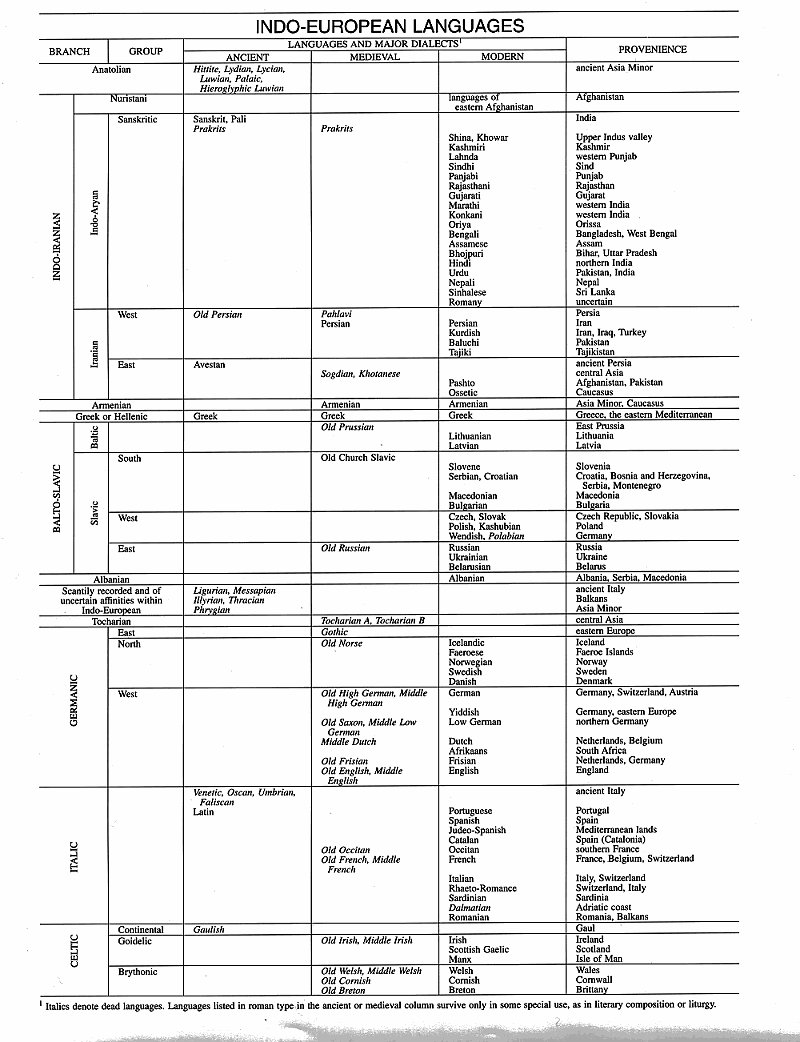
(Concise Encyclopedia)Family of languages with the greatest number of speakers, spoken in most of Europe and areas of European settlement and in much of southwestern and southern Asia. They are descended from a single unrecorded language believed to have been spoken more than 5,000 years ago in the steppe regions north of the Black Sea and to have split into a number of dialects by 3000 BC. Carried by migrating tribes to Europe and Asia, these developed over time into separate languages. The main branches are Anatolian, Indo-Iranian (including Indo-Aryan and Iranian), Greek, Italic, Germanic, Armenian, Celtic, Albanian, the extinct Tocharian languages, Baltic, and Slavic. The study of Indo-European began in 1786 with Sir William Jones's proposal that Greek, Latin, Sanskrit, Germanic, and Celtic were all derived from a common source. In the 19th century linguists added other languages to the Indo-European family, and scholars such as Rasmus Rask established a system of sound correspondences. Proto-Indo-European has since been partially reconstructed via identification of roots common to its descendants and analysis of shared grammatical patterns.
Learn More About INDO-EUROPEAN LANGUAGES
Browse
Previous Word in the Dictionary: Indo–Europeanist
All Words Near: Indo-European languages
Seen & Heard 
What made you want to look up Indo-European languages? Please tell us where you read or heard it (including the quote, if possible).