: a staff for holding the flax, tow, or wool in spinning
b
: woman's work or domain
2
: the female branch or side of a family
Illustration of distaff
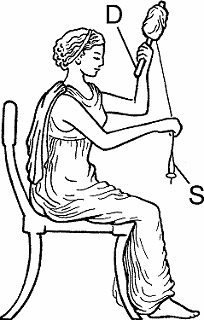
D distaff 1a
S spindle
Did you know?
The word distaff was first used for a short staff that held a bundle of fibers—of flax or wool, for example—ready to be spun into yarn or thread. Since spinning was a basic daily task customarily done by women, the distaff came to be the symbol for the work or domain of women. This symbolic use of the noun distaff dates back to the time of Chaucer and is found in several works by Shakespeare. Eventually distaff came to be used for the female branch of a family and then as an adjective, as in "the distaff side of the family."
Examples of distaff in a Sentence
Recent Examples on the Web
Examples are automatically compiled from online sources to
show current usage.Read More
Opinions expressed in the examples do not represent those of Merriam-Webster or its editors.
Send us feedback.
Adjective
An Elm Drive victory would give trainer Phil D’Amato a very successful weekend on the distaff side of the ledger.—Bill Center, San Diego Union-Tribune, 4 Sep. 2021 The personal rivalries on the distaff side became apparent during the transition: When the Bushes won, Nancy did not invite Barbara to tour the living quarters until January 11 — much later than was traditional.—NBC News, 21 Apr. 2018 Even if a separate, distaff canon is built, the atmosphere against which it’s being constructed is, gradually, becoming more integrated.—Wesley Morris, New York Times, 5 Oct. 2017 And behind the camera, Scherfig has created something of a distaff utopia: both the book and the screenplay were written by women.—Richard Lawson, VanityFair.com, 6 Apr. 2017
Noun
Davis and fellow distaff stars Shohreh Aghdashloo, Brenda Song, Toks Olagundoye, and Alysia Reiner got together to perform scenes where the script was flipped: parts that, seemingly by default, have gone to men were instead interpreted by women.—Matthew Carey, Deadline, 26 June 2025 Even Hazel’s weapons — which include a pair of weaver’s hooks, a distaff and a drop spindle — are derived from a creative force.—Justin Porter, New York Times, 7 Apr. 2025 Gascón shared a best-actress prize at last year’s Cannes Film Festival and received distaff nominations from the Golden Globes and the Screen Actors Guild, the article notes.—Armond White, National Review, 5 Feb. 2025 Of the 19 features, 10 boast a distaff helmer or co-director.—Alissa Simon, Variety, 24 Aug. 2023 This is a phenomenal distaff triple bill of country music.—Globe Staff, BostonGlobe.com, 22 Feb. 2023 Ladies take note: The distaff version has a drop panel designed for quick and easy pee breaks.—Stephanie Pearson, WIRED, 31 May 2021
Word History
Etymology
Noun
Middle English distaf, from Old English distæf, from dis- (akin to Middle Low German dise bunch of flax) + stæf staff
: a staff for holding the flax or wool in spinning
2
: the female branch or side of a family
distaff
2 of 2adjective
: of, relating to, or being a woman
the distaff side of the family
distaff skiers
Etymology
Noun
from earlier distaff (noun) "a staff for holding flax or wool for spinning," from Old English distæf (same meaning), from dis- "bunch of flax" and stæf "staff"
Word Origin
Before the invention of the spinning wheel, the spinning of yarn or thread was traditionally done by women using a spindle and a distaff. A spindle was a long spool to hold and spin the yarn. A distaff was a short rod with an opening or branches at the top for holding the flax or wool. The word distæf in Old English meant literally "flax staff," from dis- "a bunch of flax" and stæf "staff." Because women usually did the spinning, the distaff came to be a symbol for women's work. The word distaff in time took on the meaning "women's work" and later "woman." The noun distaff is rarely used in this way today, but the female members of a family are still referred to as the distaff side.